
Let me be clear from the start: I’m not saying Amazon is a broken company.
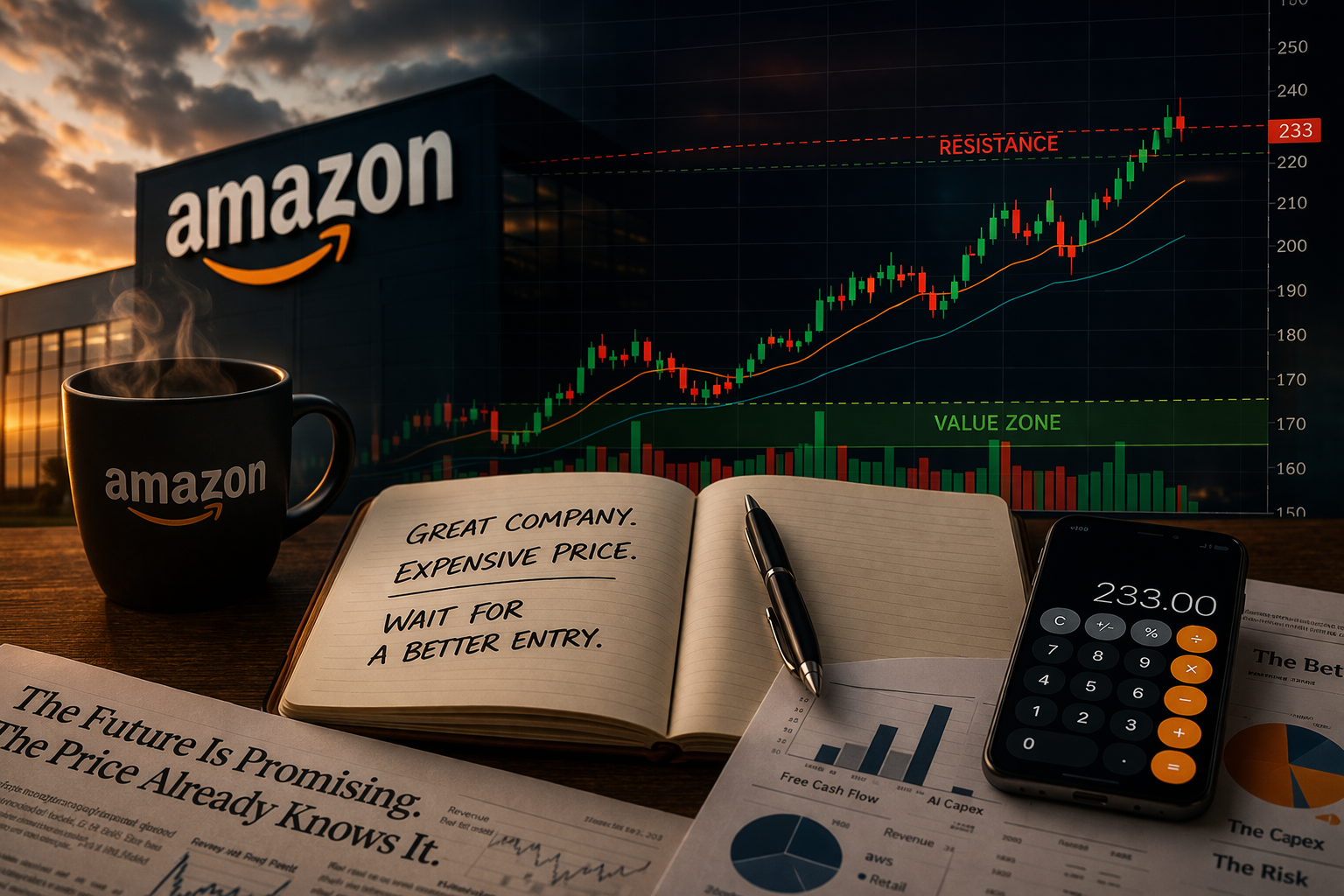
What I am saying is much simpler, and much more relevant for investors: at around $233, Amazon looks expensive to me given the amount of uncertainty still ahead.
That is my core thesis.
A lot of investors seem comfortable paying that premium because they believe Amazon’s AI investments will eventually generate strong returns. Maybe they will. Maybe Andy Jassy will be right. But that’s exactly the issue: “eventually” is doing a lot of work here.
The market is already pricing in a future that still needs to be proven.
And that matters.
The AI capex story doesn’t fully convince me
Amazon is making a very aggressive bet on AI and infrastructure. In its latest disclosures, the company outlined plans to spend approximately $200 billion in capital expenditures in 2026. That would be a major step up from the $128.3 billion spent in 2025 and the $77.7 billion spent in 2024.
Jassy is essentially asking shareholders to be patient: accept a significant drop in free cash flow today and believe this will turn into stronger margins later. And the pressure is real: Amazon’s free cash flow fell from $38.2 billion in 2024 to just $11.2 billion in 2025.
One of my concerns is that this level of spending may not be purely offensive. Part of it may reflect the cost of making sure Amazon does not lose ground in cloud, AI infrastructure, and the next layer of digital customer interaction.
There is a big difference between paying a premium for growth that is already visible and paying for growth that depends on returns on capital we still haven’t seen. If the market needs until 2027 or 2028 to judge whether this $200 billion bet is paying off, then today’s price already demands a lot of faith.
And I don’t particularly like paying up for faith.
What the bulls see — and the fair caveats
To be fair, I understand why some investors are not afraid.
There are data points that support the optimistic case. First, AWS is not firing blindly. It has a backlog of roughly $244 billion in signed contracts, up about 40% year over year. On top of that, its AI business is already running at an annual revenue pace of around $15 billion, growing much faster than cloud did in its early years.
There is also the hidden gem argument around Amazon’s own chips. Graviton and Trainium are already generating more than $20 billion a year. If Amazon succeeds in pushing more customers toward its own silicon instead of relying so heavily on Nvidia, the long-term margin implications could be significant.
So yes, I understand the bullish argument.
I just don’t think that, at current prices, investors are being paid enough for the uncertainty that still remains.
The bigger risk is not that AI fails
My main concern is more subtle: what if AI works, but not fast enough to offset damage elsewhere?
Amazon is also a giant retail and logistics machine that depends on trust, execution, and customer service.
That is where I think the market may be too relaxed.
To me, customer service is not some secondary function. It is part of the DNA that made Amazon what it is. And lately, in my view, customer support increasingly feels optimized for deflection rather than resolution. That may sound harsh, but I think it raises a valid question: in the race to fund AI and improve efficiency, is Amazon starting to put pressure on the customer experience that historically supported its moat?
If Amazon weakens service quality while chasing AI upside, then the problem is not just the size of the capex. The problem is that management may be stressing the core business while asking investors to wait for a payoff that is still unproven.
That is real execution risk.
Jassy’s letter did not reassure me
The latest shareholder letter felt more like a defense brief than a demonstration.
I understand what Jassy was trying to do. He wanted to frame this AI investment cycle the same way Amazon once framed AWS: painful in the short term, brilliant in the long term.
So he leaned heavily on Amazon’s history, its culture, and even Bezos-era symbolism.
That is exactly what bothered me.
When the numbers speak for themselves, management usually does not need to lean this hard on narrative.
When a CEO spends that much time effectively saying “trust the process,” I pay attention. Not because he is necessarily wrong, but because it tells me the burden of proof is still there.
To me, the letter did not prove the return. It defended the bet.
That is an important difference.
I’m not convinced by the chart either
Technically, I don’t love the setup here.
The move from the $200–210 area looks more like a strong rebound from oversold conditions than the clear start of a fresh upside leg. The stock has rallied sharply, filled several of the obvious open gaps from the recent move, the daily RSI looks extended, and price is now pushing into an area where multiple resistance levels seem to converge.
That alone does not make it a short. But it definitely does not make it an attractive buy for me either.
Volume adds to my skepticism.
I’m not saying there was no volume. There was. But it was not the kind of explosive participation I would want to see behind a move of this size and in this area of the chart.
A strong move in price without stronger participation does not look like a fully confirmed breakout to me.
That is why, at this level, I would rather be selling than buying.
If you bought Amazon around $200–210 and made a solid gain on the rebound, great trade.
Buying it now, after the bounce, into resistance, with the daily RSI looking extended, average participation, and no clear confirmation behind the move, is a completely different decision.
My point is simple
I am not saying Amazon is doomed.
I am saying Amazon can remain a great company and still be overpriced today.
This is not a disaster call. It is not a broken-business call. It is simply a valuation and timing call.
At the current price, I think the stock reflects too much confidence in a future that still carries meaningful execution risk.
Amazon may eventually justify a much higher valuation. But that is not the same as saying the stock is attractively priced today. Markets do not only price long-term potential; they also price present conditions, execution risk, and what still has to be proven.
That is enough for me to stay on the sidelines.
From a technical point of view, I’m not interested in buying at current levels.
What matters to me now is how price behaves here, and then around the $220–230 area and the $200 level if the stock starts pulling back.
Those are the zones I would be watching most closely.
I’m not trying to call an exact bottom. But if Amazon eventually traded closer to the $160–180 area, that would look like a far more attractive entry to me — not just technically, but also in terms of valuation and margin of safety.
For now, though, up here, I do not find the risk/reward attractive.
And in investing, that is already a good enough reason for me to pass.
🟢 Disclosure: The author does not hold a position.
⚠️ I produce these analyses for my own enjoyment and because I’m always looking for new opportunities. I am not a financial professional, and I don’t have access to professional-grade tools or proprietary data. Everything here is built from publicly available information and my own reasoning — which means I can be wrong. This analysis may include forward-looking statements based on current expectations and projections; these are subject to risks and uncertainties that could cause actual results to differ materially from what is discussed here. I may not always see the full picture, and my views will change as new information emerges or as I come to understand data points I initially overlooked or underweighted. However, I am under no obligation to update or keep this information current as the situation evolves. I only operate with cash positions — no leverage, no margin, no shorting. I never bet against the market or individual companies. My opinion may be based on fundamentals, market behaviour, or a mix of both. The company is not its price, and the price is not the company. I express my own opinions. I am not receiving compensation to share this. I have no business relationship with any company whose stock is mentioned in this article. Nothing here is financial advice. Do your own due diligence.